Jan 15, 2026
In DeFi, most “lending” protocols don’t price credit. They price liquidity.
And when you price liquidity with a kinked utilization curve, you get a system that behaves calmly… until it doesn’t.
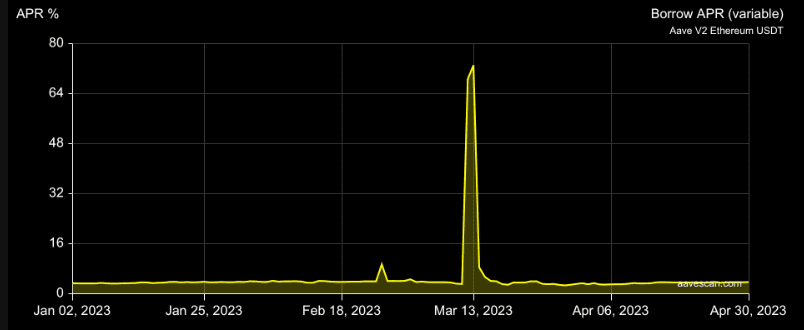
On March 11, 2023, during the USDC depeg, Messari reported that USDT borrowing on Aave’s Ethereum v2 market briefly hit 87% APR.
Not 8.7%. Eighty-seven.
That spike wasn’t because USDT suddenly became “riskier collateral.” It was because the pool’s utilization curve did what it is designed to do: punish borrowing when the pool is stressed, so the protocol can attract deposits and preserve withdrawal liquidity.
Aavescan’s historical write-up documents the same episode as a major Aave rate event, describing USDT borrow rates above 60% APR during the depeg window. (Different sources summarize the peak differently; the point is the same: rates went vertical.)
If you borrowed in a pool, that was your problem even if your position didn’t change.
If you borrowed at a fixed rate for a fixed term, it wasn’t. (That’s the whole point of credit.)
Pools don’t “set a rate.” They run a utilization throttle.
The Banque de France describes how major DeFi protocols set interest rates: borrow rates rise with utilization (borrowed ÷ deposited) and rise very sharply beyond an inflection point that targets ~80–90% utilization, with very high rates possible when borrowers and lenders are imbalanced.
Aave itself describes this design as a “double slope” curve meant to keep enough liquidity available for withdrawals, while rewarding depositors more as liquidity tightens.
Compound similarly documents a utilization “kink” after which rates increase more rapidly.
That is a rational design for liquidity management. But it creates two permanent rate problems for users:
Problem 1: A structural wedge between what borrowers pay and lenders earn
In a pool, suppliers earn less than borrowers pay because (a) utilization is usually below 100%, and (b) a portion of borrow interest is diverted to protocol reserves (“reserve factor”).
Aave’s interest rate strategy code makes the relationship explicit: the liquidity rate is derived from the variable borrow rate multiplied by a usage ratio and reduced by the reserve factor.
The Banque de France summarizes the same idea more simply: the deposit rate is generally the borrow rate multiplied by utilization.
So unless utilization is near 100%, the pool mechanically forces a wedge.
This wedge isn’t “mysterious fees.” It’s what a shared pool needs to remain withdrawable.
But from a rate standpoint, it’s still friction: borrowers pay it; lenders don’t receive it.
Problem 2: Rate shocks are a feature, not a bug
When fear hits the market (or an opportunity like an airdrop appears), borrowers rush in, utilization spikes, and the kinked curve is designed to spike rates.
That’s not hypothetical. It is documented on-chain:
USDC depeg (March 2023): Circle disclosed $3.3B of USDC reserves were at Silicon Valley Bank during the failure window. Aave’s USDT borrow rates surged, with Messari reporting a temporary 87% APR and Aavescan documenting borrow rates above 60% APR.
Ethereum PoW fork dynamics (September 2022): Aavescan documents Aave’s ETH borrow rates above 90% APR as traders borrowed ETH to maximize fork snapshot exposure.
If your cost of capital can go from single digits to 60–90%+ overnight, you don’t have credit—you have a utilization throttle.
What peer-to-peer matching does differently
Peer-to-peer markets let borrowers and lenders agree on a rate directly (often inside the pool’s wedge) rather than accepting whatever the utilization curve spits out.
Morpho’s historical Optimizer design is a clean proof: match borrowers and lenders directly while preserving the underlying pool’s collateral factors and liquidation parameters, so the effective rate stays between pool borrow and pool supply.
Morpho governance formalized the peer-to-peer rate as a convex combination of pool borrow and pool supply rates (rᴾ²ᴾ = α·rᴮ + (1−α)·rˢ).
In one commonly used illustration, a pool supply rate of 3.67% and pool borrow rate of 6.17% can be compressed to a 4.46% matched rate—raising supplier yield and lowering borrower cost at the same time.
Even if you disagree with the framing, the mechanical point is indisputable: if you can legally set a rate anywhere between rˢ and rᴮ, you can improve both sides simultaneously because pools only give you the endpoints.
The “stable rate” in pools isn’t the same thing as a fixed rate
Aave introduced a stable borrowing mode to reduce volatility. But even Aave’s own explanation includes a caveat: stable borrowers can be “rebalanced” upward when the protocol needs liquidity and supplier yields must rise.
More recently, Aave governance proposed fully deprecating stable rate mode in v2 and v3, moving remaining stable positions to variable, citing complexity and a critical bug report as part of the motivation.
Translation: even “stable” in a pool is still a pool product, not a true fixed-term credit contract.
A rate argument that scales with the market
At the time of writing, DeFiLlama reports $32.443B in total borrowed across protocols and $52.711B TVL in “Lending.”
Small, structural rate wedges across this base add up.
And there’s demand for credit that behaves like credit. Aave’s own stable-rate discussion notes users value predictability and accepting fixed terms for stability.
Where Floe fits
Floe is an intent-based, peer-to-peer structured credit protocol where users post lend/borrow intents that are matched and settled as isolated loan contracts. Not shared pools.
Floe’s public materials emphasize: custom rates/terms, per-loan isolation, maturities, prepayment options, and eliminating idle pool capital, explicitly positioning this as a way to tighten spreads and avoid pool-driven rate shocks.
That doesn’t mean “pools are obsolete.” Pools are great at instant liquidity and open-ended borrowing.
But from a rate standpoint, the pool architecture has two unavoidable constraints:
Structural wedges
Utilization-driven rate shocks, both of which that Floe is built to remove.
Disclosure: This is an informational analysis of mechanism design and historical rate behavior, not investment advice.